
Count the work you completed
The muscle-balance calculation uses completed sets from workout history. Skipped exercises do not add volume. A planned exercise is not proof that the work happened, which is why finishing the log matters.
Primary-muscle work receives one set of credit per completed set. Secondary involvement receives half a set. These weights are a tracking convention, not a direct measurement of muscle growth or the effort of each fiber.
A simple set-credit example
| Logged work | Primary credit | Secondary credit |
|---|---|---|
| 3 completed bench-press sets | 3 chest sets | 1.5 sets for each mapped secondary area, such as triceps |
| 2 completed curl sets | 2 biceps sets | Only areas listed as secondary receive secondary credit |
| A skipped exercise | 0 | 0 |
This is an illustration of the counting method. The exact areas depend on the exercise's muscle mapping. Shared work across presses and pulls means the final view can contain fractional sets.
A small isolation set and a demanding compound set are not physiologically identical. Interpret the numbers alongside effort, exercise choice and recovery rather than trying to maximize every total.
Use trends before adding more work
The view compares the current week with longer periods of logged training. Targets can reflect your selected focus areas and profile. A new log contains less evidence than several consistent weeks, so an early gap deserves investigation before an aggressive change.
Ask whether a low number reflects a missing workout, an incomplete log, an exercise classification, or an actual programming gap. A persistent shortfall alongside good recovery may justify a modest change; a single quiet week during travel may not.
What the map can and cannot tell you
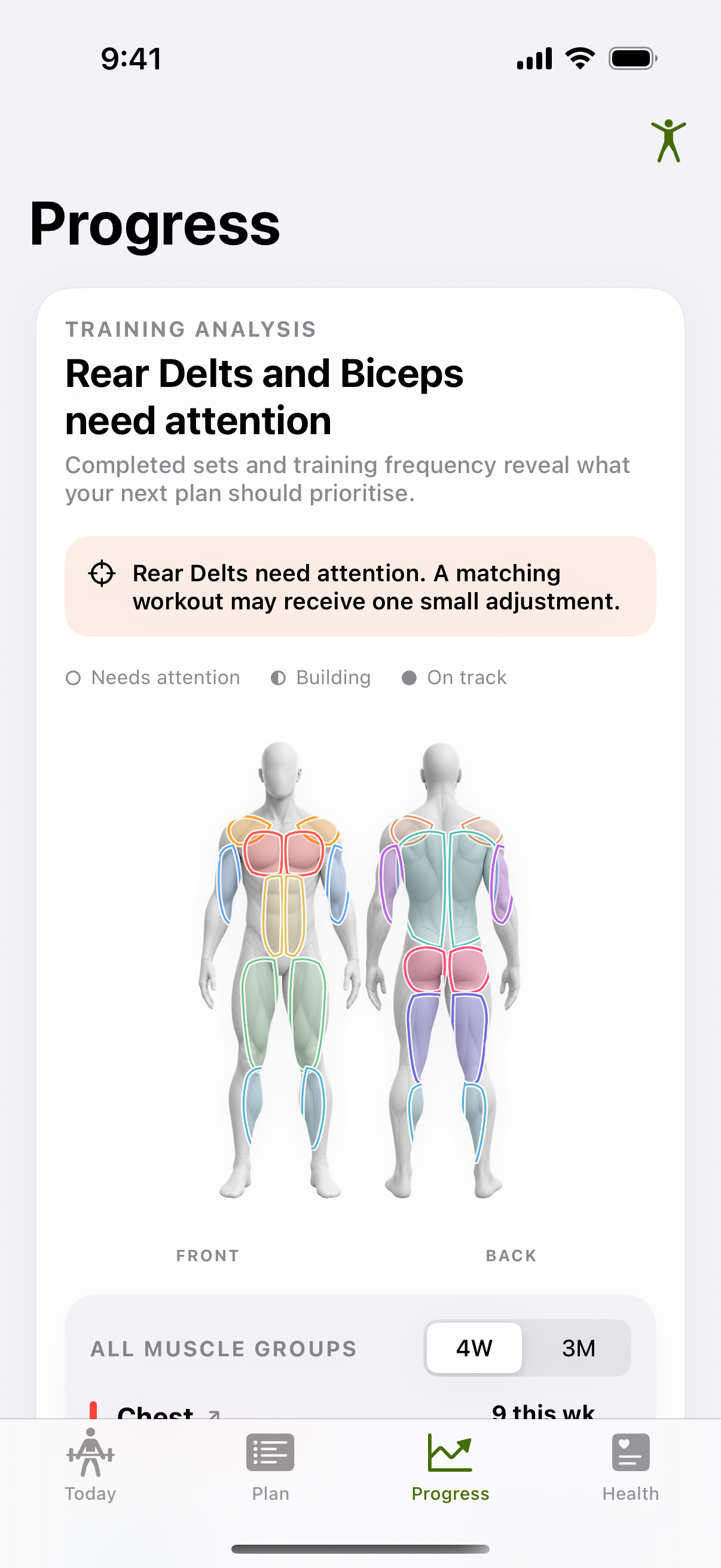
The map describes recorded training coverage. It does not scan your physique, diagnose a muscle imbalance or measure recovery directly. Your logs can omit activities performed elsewhere, and the set-credit system cannot capture every difference in exercise quality.
Use it as a prompt to review the plan. For example, if most sessions are presses and little pulling is recorded, first check that your back exercises are logged accurately. Then consider a practical adjustment to the next week rather than adding random work to an already tiring day.
Turn an observation into a useful change
- Review a muscle area alongside its recent history and your chosen priority.
- Check the underlying completed sets before changing the target.
- Keep the main exercises stable enough to compare performance.
- Add or redistribute a small amount of work only when time and recovery permit.
- Reassess after repeated sessions rather than expecting the color map to prove immediate growth.
Muscle-volume tracking questions
Why are some totals fractional?
Secondary muscles receive partial credit. In this calculation, three secondary sets contribute 1.5 credited sets to the mapped area.
Does a low total mean a weak muscle?
Not necessarily. It may reflect missing logs, a short week or the way an exercise is classified. Training coverage and physical weakness are different things.
Should every muscle have the same target?
No. Priorities, exercise overlap, experience and recovery affect useful targets. The numbers are a guide to reviewing your own week.
App access
Adapt Fitness is built for iPhone. Pro subscriptions are offered in the app; check the current paywall for included features, pricing and trial eligibility before purchasing. Screen appearance and availability can vary by version.
Put it into practice
Make the next session easier to plan.
Choose your plan, review your session and log the work you actually complete.
Get Adapt Fitness ↗